

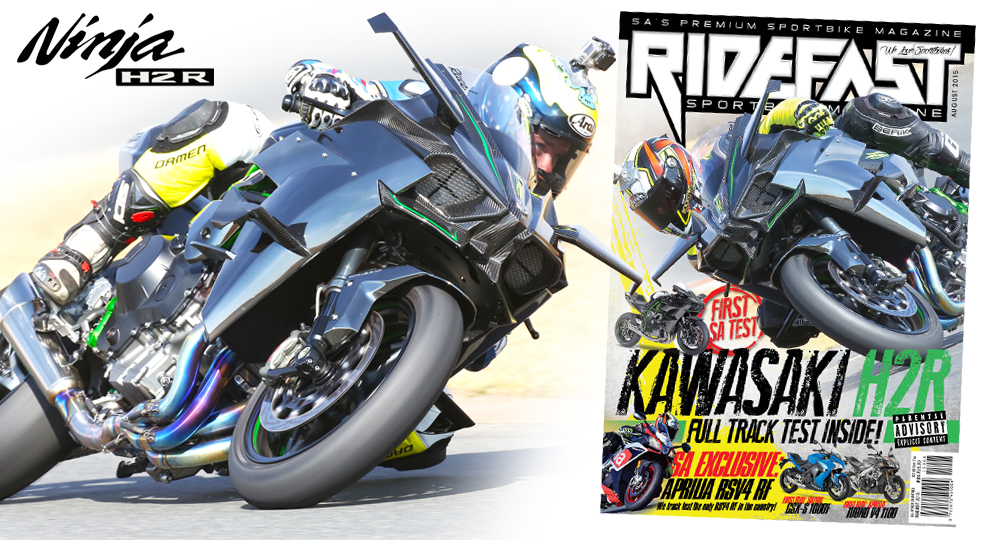
Yes. Three hundred horsepower. That’s what Kawasaki’s absolutely deranged Ninja H2R is claimed to be putting out. They say it was made “to offer the kind of acceleration most riders had never experienced.” Apparently you have to qualify that statement with “most” because of the handful of riders that also pilot SR-71 Blackbirds.
Seriously, there’s no way to overstate this kind of power. The closest thing on two wheels is BMW’s new S1000RR, which manages a measly 199 hp. That makes the H2R the most powerful motorcycle ever produced.
Obviously, it’s not built for the street. There are no turn signals, no mirrors, and no headlight/tail light. Seventeen-inch racing slicks are mounted at each end and that exhaust couldn’t pass a dB test at idle. Truly a bike built for us here at RideFast Magazine.
Oh, that styling! You either love it or hate it, but how can you hate it? It won’t let you hate it and, if you do, it doesn’t care. It’s got that attitude about it that says, “love me or hate me, I don’t care, but you will respect me!” It’s like that bully you had at school who you detested but wanted more than anything to be like.
What is the H2R all about?
The H2R’s headlining 300 hp claim is made possible by the use of forced induction. A centrifugal supercharger, developed in-house with assistance from KHI’s aerospace division, feeds the H2’s liquid-cooled Inline Four. This bike is powered by a liquid-cooled, 4-stroke, 998cc, Inline Four unit. Its 50mm throttle bodies – 6.4 % bigger than its competitors – allow the engine to breathe deeper and generate more power. Fuel injection makes for effortless cold starts and smooth power delivery. The 8.3:1 compression ratio is low enough to put it in the bottom 10% of all 2015 supersport bikes. A cylinder bore and stroke of 76 x 55 mm makes this motor oversquare: the bore (width) of the cylinder is greater than its stroke (length). Oversquare engines excel at revving high and producing a lot of power for their displacement, but at the expense of low-end torque.
The trellis frame – a first for Kawasaki – is there to both harness the power and balance the flex under load, and rather than going with a long wheelbase for straight-line stability, they’ve opted for sports bike geometry and some aero bits to keep things stable at high speeds. That also means it will turn and steer, or will it?

Engineers designing for higher speeds must battle wind resistance, as there comes a point where raw horsepower can’t overcome the simple force of drag (as many land speed racers will attest). This is where aerodynamics comes into play, and the 300 hp H2 is fitted with bodywork developed with Kawasaki’s aerospace division that “both minimizes aerodynamic drag and increases stability when riding at speed”.
The most dramatic pieces of the carbon fiber bodywork are the wing-like, downward sloping fins flanking the windscreen and mid fairing. Wind tunnel design also played a hand in the carbon fiber cowling/upper fairing, which channels air into the Ram Air duct and supercharger. The liberal use of carbon fiber is complemented by a mirror black chrome paint developed specifically for the H2.
Front brakes, probably the most important feature on the H2R as it has to stop all that cover, consist of dual 330 mm, 4-piston discs. In the rear, providing support, is a single 2-piston disc measuring 250 mm in diameter.
With a curb weight of 216kg, it is heavier than the norm. The average 1000cc supersport bike has a curb weight of 200kg, despite having all that carbon fibre fitted.
Track Time:
Finally, after over two months of organising and waiting, it was time to ride the beast. Insurance was sorted, tyre pressures were checked, everything was in order and we were ready to go. I have not had butterflies in my tummy like this for a long time.
As soon as you fire up the H2R, you know you are in for one hell of a ride. It seriously sounds like a MotoGP bike, but a bit more like the screamer Honda than the deeper sounding Yamaha. It’s a sound that edges through your ears, rattling your brain on its way down to your chest, passing through your ribs, exciting the heart rate, eventually making its way down to your toes that are now standing up. It really does make all the hairs on your body stand at attention!
I spent the first couple of minutes asking Gareth from Holeshot motorcycles to explain how to set up the key electronics. I wanted full power, but with traction and wheelie control set on level 4. Not because I didn’t think I could handle the bike, but rather down to the fact that I did not want my insurance company hitting me with a massive excess.
After sorting out the electronics, I fired the beast up, selected first gear, and headed out on track. I could not believe this was happening, I was actually riding a R640 000, 300 hp motorcycle. Not many people can say that. I don’t even want to know how poor Anton was feeling watching me ride out of pit-lane on his R600k plus machine.
I immediately sunk into the comfy seat and riding position, which is very similar to the standard H2 I had tested a few months before. The riding and seating position is slightly more aggressive on the H2R, as one would expect. I was glad to find that there was plenty of room for me to move around, as I knew I would be doing plenty of it while wrestling this beast around the track. I used the first couple of laps to warm up the Bridgestone slicks- tyres I had never ridden on before. My confidence was soon given a big boost with the tyres and chassis feeling surprisingly good, stable, and easy to manoeuvre.
Thrashing it down the back straight for the first time, I was quickly reminded that I was riding a 300 hp machine. This thing accelerated faster than anything I had ever been on before. First, second, third and fourth gear were a blur. I could honestly not tell you what rpm I revved it to, or what was going through my mind at the time. The 700m back straight was over and done with quicker than with anything I had ever taken down there before, and I have taken all the latest and greatest bikes down this particular straight, including the new R1, S1000RR, and Aprilia RF. None of them comes close to the H2R’s acceleration. The Kawasaki is easily 20-30% better and faster in this respect. Thank goodness the traction and wheelie control were on though I will say that the level 4 setting was far too restrictive for my liking. I quickly pulled off and changed it down to level 2.
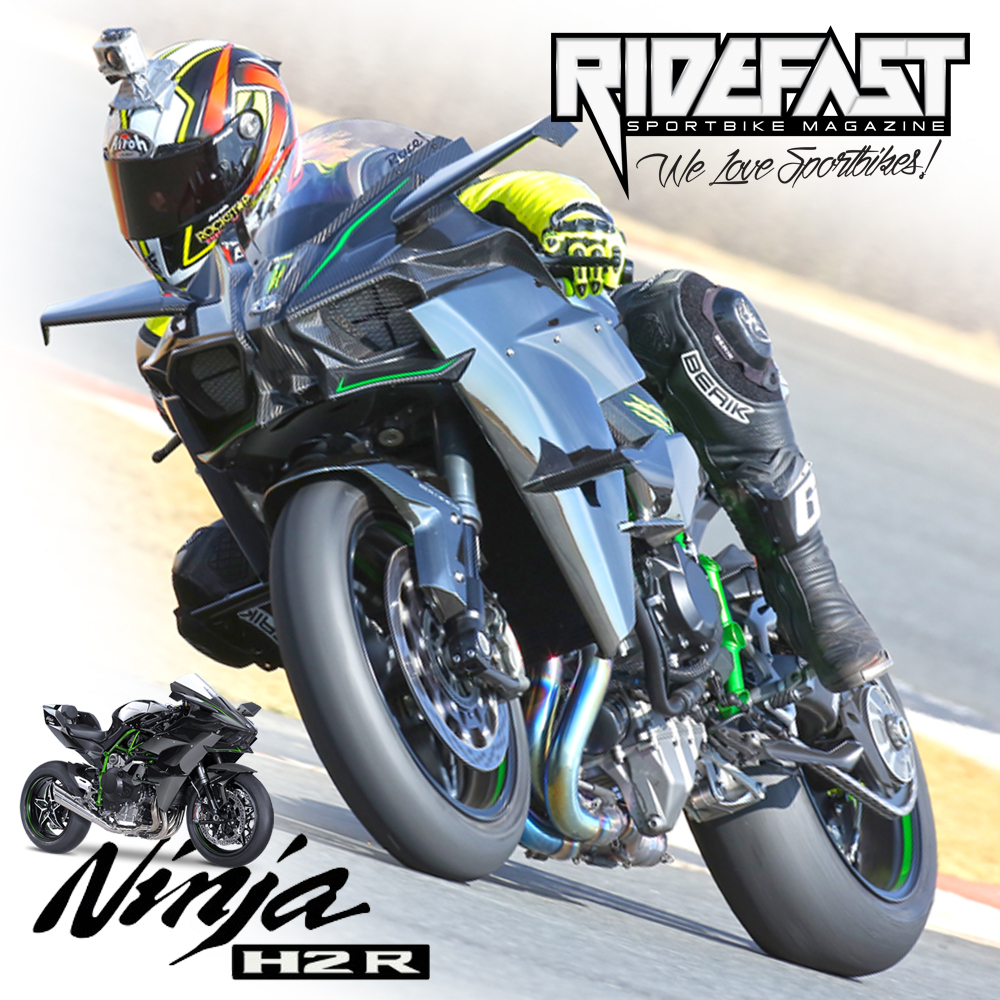
I was really starting to enjoy the ride while cranking the bike through the back section of the track. Flicking it through the tight section was a breeze, though looking at the bike one would be forgiven for thinking that it would be lazy through the tight stuff. However, this was far from the case. Getting the bike into and through the turns was not the problem, it was holding onto to it coming out of them that was a challenge. I have never, and probably never will, wrestle an angry bull or wild animal, but I can imagine it being close to what I was experiencing wrestling the H2R out of the turns. Even with the traction and wheelie control activated, I still had to shift my weight and move my body all over the bike to keep it planted.
Man, this was the best feeling ever! I was literally crying and laughing at the same time in my helmet; it’s that same overwhelming feeling that takes over when you are on a rollercoaster.
Shifting through the gears was effortless and smooth, and nothing beats that spluttering, popping sound of the traction control and supercharger working overtime through every gear.
If there were a microphone and GoPro fitted to my helmet, you would have been exposed to some of the most explicit language you would have ever heard in your life, as well as some of the funniest facial expressions ever seen. I was cursing at every opportunity, not out of fear, but rather pure excitement. It would have easily been a YouTube sensation!
The throttle was not the smoothest nor easiest to handle, it was either on or off, with really nothing in between. Anton had warned me of this before heading out, and thankfully he did because it could have easily caught me out.
You can take what I said about the H2 (featured in our May issue) and multiply it by three, then you might come close to the reality of the H2R. You can also (just about) double the price.
The H2R actually felt really good around the RSR track, and if I did not have to worry about paying for crash damage, I reckon I could have set some decent lap times on this bike. Look, it’s still not going to match the lap times of an R1 or Aprilia RF, it’s just simply not built to do that, though it’s not as far off as I imagined it would be.
We always want more, more power, more speed, more excitement; it’s what makes us tick and it’s like a drug to most of us. This is what the H2R was built for, to push those boundaries we have become accustomed to, taking what we already know and pushing it even further. The H2R was not built to dominate tracks and break lap records, it was designed to break all the rules, and that it most certainly does!
Shez says:
The first thing everyone has asked me about the H2R is: “Is it the fastest bike you have ever ridden?” The answer is a resounding “yes”. I have been fortunate enough to have ridden some incredible World SBK machines, but I can honestly say the H2R is more powerful than any of them. Not by much, mind you, but definitely faster. The acceleration is mind blowing, and to think this was at high altitude! I would love to feel what the H2R is capable of down at the coast, around, say, the East London track, where we could at least open it up a bit down those long straights, although I’m sure they won’t seem that long on this bike.

Accelerating through the gears down the back straight was something I will never forget. As Rob mentioned, you literally cannot remember a thing, it’s all just a blur. I loved the fact that, although the traction and wheelie control did work overtime, it did still give the bike a bit of room to let loose, restricting it but not in a boring way, still allowing you to enjoy the bike.
I did get a bit of a fright braking hard for the first time at the end of the straight, to be honest. The front forks were so soft that they were just hitting the bottom, which meant it was struggling to stop. So, I pulled into the pit and let my dad work his magic. The changes he made were huge, and the bike felt much more stable and was stopping much better than before.
I would love to be let loose on this bike, for Kawasaki to just say to me “go and do fast lap times, don’t worry about crashing it”. I think it would not be too far off race bikes lap times. The chassis worked really well, and I had to stop myself on a few occasions from getting over excited and cranking the bike, elbow down, MotoGP style.
Overall, what an amazing machine this is. It’s built to excite and it does just that! I want one!
H2 vs. H2R:
It was such a relief riding into the pits after completing the test of the H2R. It felt like a huge weight had been lifted off my shoulders. I had spent the entire week leading up to the testing stressing about the fact that, should anything happen to the bike, it would have cost me a fortune. But, minutes after returning to the pits, Errol, the man from Bike Hospital, came to me and asked if I would please take his road H2 out on the track against Shez on the H2R, just to do a speed check down the straights. I was very hesitant in saying yes, as this is normally when bad things happen, but I could not decline an opportunity like this. So, Shez and I once again suited up and headed back out onto the track.
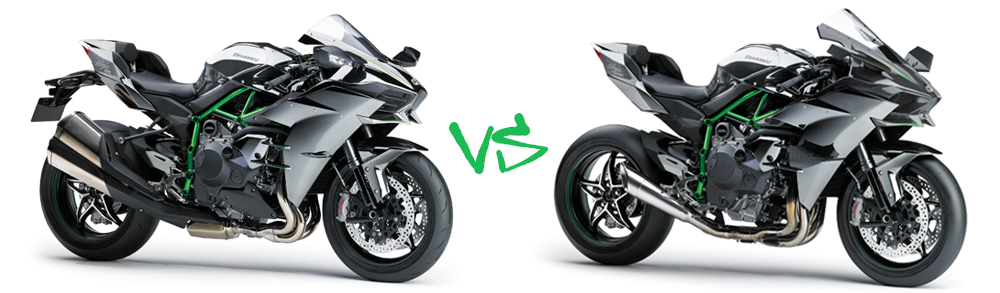
I could immediately feel the difference in weight between the two bikes. The H2R is around 25kg’s lighter than the road H2, and like I said, you can feel it right away. Errol had done an amazing pipe conversion on his H2, replacing the disgusting looking stock pipe with one that resembles the H2R’s. I actually thought it was a pipe from the H2R, and was shocked that Errol had gone and spent the R140,000 on purchasing the ‘R’ pipe from Kawasaki. He quickly shut me down, saying that he made the pipe himself. What a great job he did. Not only did it look amazing, but it also sounded a hundred times better!
The plan out on track was to take a lap to heat up the tyres, then once on the back straight, do a roll-on launch in 2nd gear at 4000rpm. To my, and I’m sure Shez’s surprise, the road H2 actually launched faster initially. It managed to hold the H2R up to high rpm in 3rd gear, but from there onwards the H2R roared into life and thrashed the road H2. The best way for me to describe it is like a 1000cc pulling away from a 600cc, there really was that much of a difference.
Final word:
We did four roll-on tests, and all four pretty much had the same outcome. The H2 definitely has the shorter gear ratio in 2nd gear as it was able to launch that little bit ahead of the H2R. You can’t blame Kawasaki for making the R’s gear ratios a bit longer, because any shorter and the bike would essentially just flip over in lower gears. We also did a roll-on in 2nd gear at 6,000rpm this time, and this was when the R dominated from the word go. No doubt the traction control also limited the R’s performance at such low rpm, so once it got to the higher numbers it was gone!
The H2R was also way easier to handle around the track, the weight difference once again playing a key roll in that. The Bridgestone slick tyres fitted to the R also contributed to this, as the H2 is fitted with Bridgestone R10 cut-slicks, which did the job just fine.
To end off, we would just like to take this opportunity to thank everyone involved who made this test possible: the guys and girls from Holeshot Motorcycles, Kawasaki Motors SA, Redstar Raceway, all the supporters who came out to see the beast in action and, of course, Anton Oberholzer, who stuck to his word and let us test his R620,000 supercharged brute. A big thanks also goes to Errol for letting us test his H2, making this test even more worthwhile!
Article by RideFast Magazine